Course FAQs and Guides
Course FAQs and Guides
Ink Sketching: The Sketch Loose Method
Goals and introductions
Goals and introductions
Workshop Two: Depth and Texture: Mastering Hatching and Value
Workshop Two: Depth and Texture: Mastering Hatching and Value
Workshop 3: Finding the Flow: The Art of the Continuous Line
Workshop 3: Finding the Flow: The Art of the Continuous Line
Workshop 4: Less is More: Sketching with Economy and Purpose
Workshop 4: Less is More: Sketching with Economy and Purpose
Workshop 5: The Big Picture: Taming Complex and Challenging Scenes
Workshop 5: The Big Picture: Taming Complex and Challenging Scenes
Closing thoughts
Closing thoughts
Who is this course for?
This course is designed for anyone who wants to loosen up their ink sketching and stop overworking their drawings. You might be a complete beginner, or you might be an experienced artist looking to simplify complex scenes and find a more expressive style.
Unlike my foundational courses, this one dives deep into specific concepts like the continuous line, economy of line, and using composition to map out your page. You will get feedback on your art from me as we work through these ideas together.
The paid courses are designed to work together and not overlap. While there is naturally some overlap in the fact that we are using a pen, this course is uniquely focused on building your confidence to do less on the page while saying more. If you are eager to embrace a looser style and start experimenting bravely with your linework and subtle ink washes, this is for you.
What supplies are suggested?
For most of this course, I use beginner-friendly supplies, but you will notice I have a particular love for fountain pens! We cover tools in more detail later, so there is no need for an exact shopping list right now. However, here are some broad guidelines for what you will need.
Supplies can often be a source of anxiety - rest assured, there is nothing you NEED for this course except for pen and paper. And if you have any questions, send me an email: toby@sketchloose.co.uk
-
Firstly, pens ... you will need one of either:
A fountain pen: This is my personal tool of choice. Fountain pens are wonderful because a single pen can give you a huge variety of marks. You can get light, scratchy lines (sometimes just by flipping the nib upside down) and bold, juicy lines simply by changing your drawing speed or pressure.
OR Alternative pens: If you do not use fountain pens, that is absolutely fine! You can just use a fine pen (like a 0.03mm or 0.1mm fineliner) for your light, searching lines, and a bolder pen (like a 0.5mm or 0.8mm) for your structure and deep shadows.
Water-proof ink: You can find exact examples of this on the supplies tab above. Most fine liners are water-proof anyway, whilst if you are using a fountain pen you may want to invest in some fountain pen safe ink.
Water-soluble ink: Standard fountain pen ink is naturally water-soluble, which is perfect for the wash techniques we use in this course. If you are using waterproof fineliners instead, try to have a basic rollerball pen or some watercolor pencils on hand for the ink wash experiments.
Paper: A sketchbook with decent-quality paper that can handle a light wash of water (e.g. 150gsm minimum)
A brush: A simple wet paintbrush (or a water brush) to activate your ink. Specific size is absolutely not important.
There are no hard rules here. This course is not about having the perfect kit; it’s about making the most of what you already have. There’s no need to buy anything new, just bring your current materials, your curiosity, and a willingness to experiment!
Is there a time limit?
There’s no time limit on this course. Work through the lessons at your own pace, and feel free to revisit any part of the course as often as you like to refresh your memory on a specific technique.
Common FAQs and where to find answers
👉 View the supplies I use most often
👉 How to log in and find your course dashboard
👉 How to post your photos and get feedback
👉 My photos are too big to post, how do I make them smaller?
What is the quality of the videos?
All videos are available in full HD or 4K quality.
To make sure you're watching in the best resolution, click the ⚙️ settings icon in the bottom-right corner of the video player and select the highest quality available (1080p or 4K).
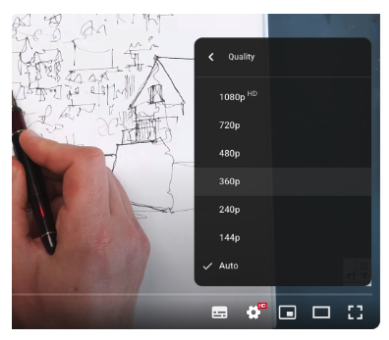
If the video looks blurry or out of focus, it may be due to a slow internet connection, so try adjusting the quality manually using the settings menu.