Suggested Supplies
Suggested Supplies
Advancing Tone, Value and Colours
Introduction
Introduction
What do you hope to achieve?
What do you hope to achieve?
Watercolour Effects
Watercolour Effects
Conclusion and Next Steps
Conclusion and Next Steps
What supplies might we need or want?
We will be focussing on ink and watercolour techniques in this class, but my style of sketching is loose and approachable - requiring only a small selection of supplies.
As such, the required and suggested supplies are quite minimal and very flexible.
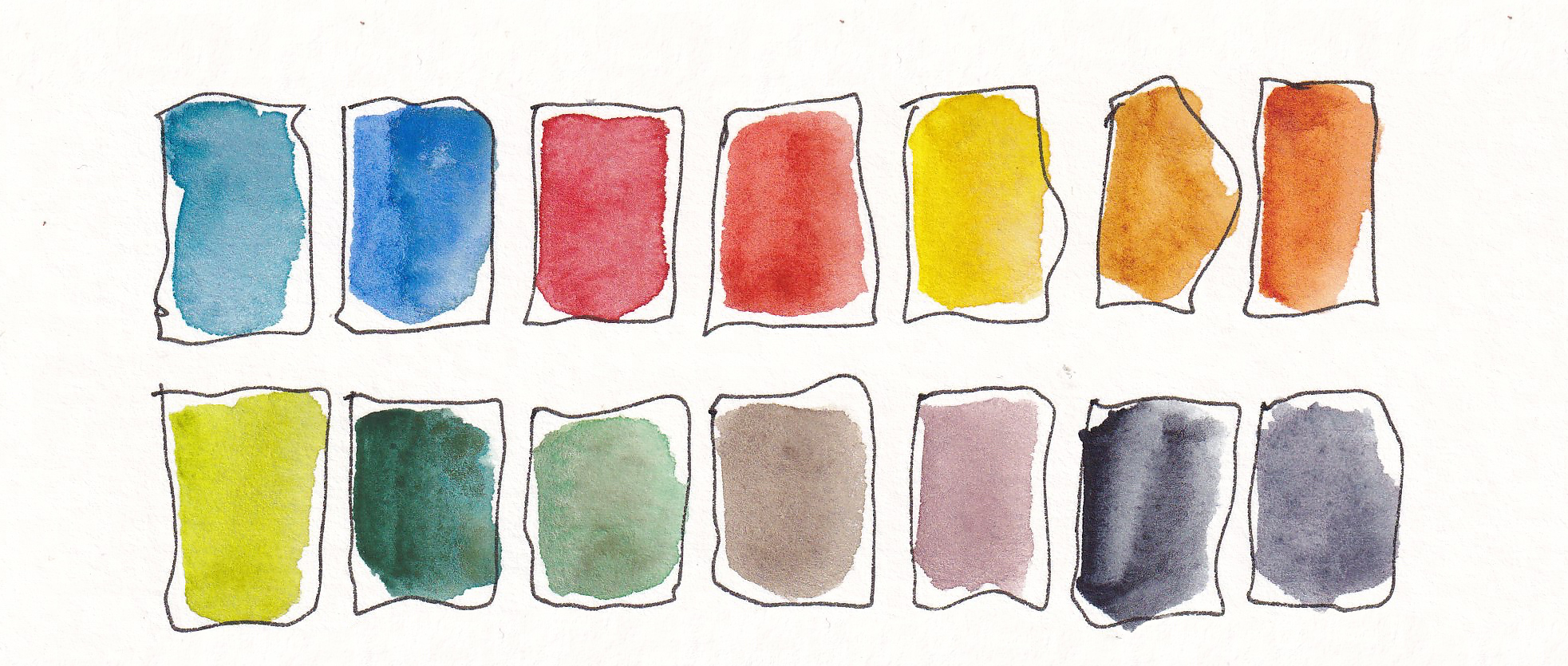
These are my watercolours all swatched out - you can find out more about them in the handout, and in the links below.
Minimum Suggested Supplies
Surface - student grade watercolour paper, 300gsm (140lbs) in weight, A4 (UK) or Letter (USA) in size. I prefer cold pressed paper. This paper might be in loose sheets, or in a sketchbook - either is fine
Drafting implement - any pencil, any eraser
Sketching implement - a waterproof fineliner, or a sketching fountain pen (a cheap option is a 'Platinum Preppy'). Look for the words 'permanent' or 'waterproof' on the fineliner.
-
Ink - A waterproof ink, such as platinum carbon X ink.
Important note here - not all waterproof inks are fountain pen safe. I have written a blog here about the inks I use - CLICK HERE.
Watercolour paints - a student grade starter set is an affordable option and plenty to get started.
Watercolour brush - as a minimum, I would suggest student grade size 6 and 12 round brushes. These sizes are approximate and just a guideline.
Recommended Supplies
Surface - Professional grade watercolour paper, cold pressed, 300-450gsm (140-200lbs), A4/Letter in size, 100% cotton. My preference is for sketching on gummed 'blocks' of watercolour paper
Drafting implement - a 0.5mm mechanical pencil, such as a Rotring Tikki, and a putty eraser
Sketching implement - my favourite is a fine tipped LAMY Safari fountain pen
-
Ink - A waterproof ink, such as platinum carbon X ink
Important note here - not all waterproof inks are fountain pen safe. I have written a blog here about the inks I use - CLICK HERE.
-
Watercolour paints - 5-6 professional grade pigments is more than enough.
If I were to choose an absolute minimum palette for me it would be cobalt blue, hansa yellow medium, scarlet lake as my three primary colours, one of quinacridone sienna or quinacridone gold as lovely warm colours, and two from indigo or Paynes grey or moon glow or sepia as tonal/value colours.
Watercolour brush - adding a 1 inch flat brush to your collection is helpful for some of the 'direct watercolour' effects we'll be using
Other supplies
Through the course we'll make use of a few other things that you might want to experiment with.
These include wax, salt, spray bottles, tissues, towels, and lots more little everyday type objects.