- Sep 18, 2024
Doodle... From Beginner to 'Advanced'
- Toby Haseler
- 2 comments
I've recently been filling up sketchbooks with doodles.
OR rather, the doodles I've been filling up my sketchbook with have become more complex and intricate. And, perhaps, more fulfilling as well.
At least in the sense of being mindful, and letting my brain wander and move.
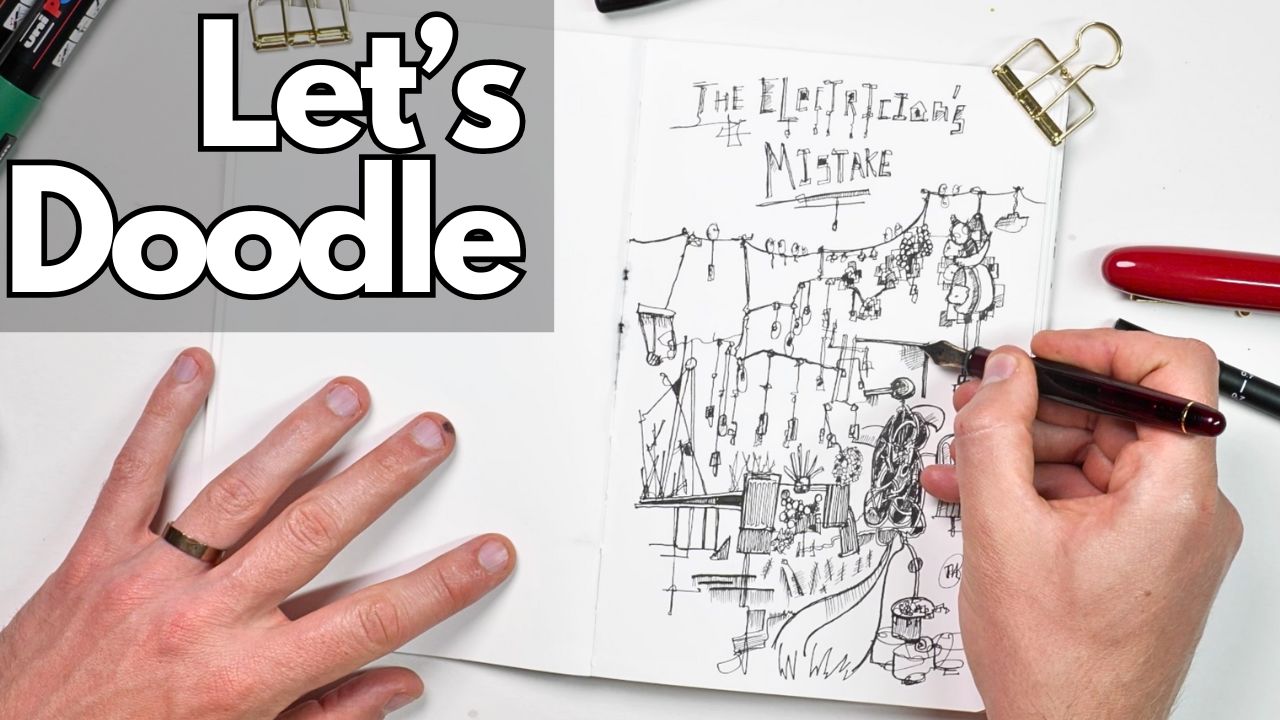
How did I achieve this?
You can watch my video above where I sketch 'The Electrician's Mistake' and give you a tour of my sketchbook.
You'll also be able to get an idea of the processes that I've been working on too.
Because, as ever, it comes down to process - not random chance, not unheralded creativity or a newly enlightened state. Just simple processes and an open mind.
Basic techniques
All of the techniques discussed below (and more) are shown in detail in my latest SkillShare class which you can find linked HERE (https://skl.sh/3MONtgL).
The key behind these techniques is repetition of simple ideas, whilst also allowing yourself to create a story or pattern amongst it all.
Let me expand and explain...
Sticks and tubes
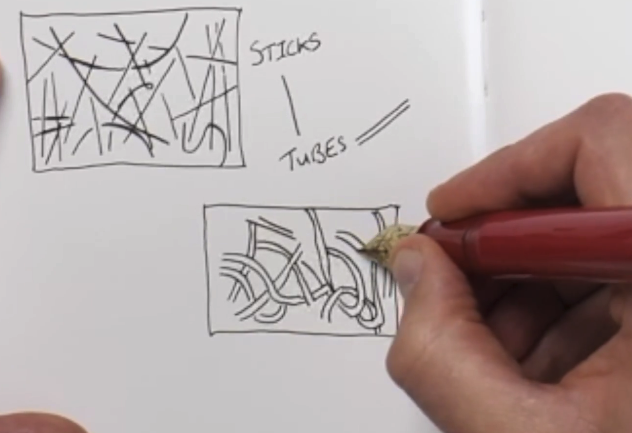
First we have the ideas of sticks, which are one dimensional. These single lines can criss cross, have gaps, tangle together and create the illusion of spagetthi or noodles thrown together.
Building on this we create 2D tubes or pipes. Here the illusion of depth starts to build.
Leaving gaps when you first start to drawn enables you to slowly build up the ideas here, rather than have a creative vision at the start. Notice, in both the sticks and the tubes how there are lots of incomplete marks. These can be finished later... or not at all.
Shapes
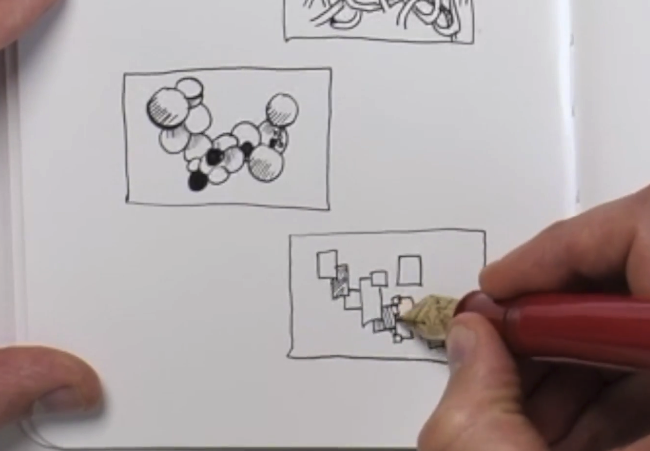
Next we have overlapping shapes, where ideas like hatching and blacking in (creating contrast) start to also be important.
See how the random assortment of simple shapes starts to come together and create 'something'.
What that something is... is part of the story.
Objects
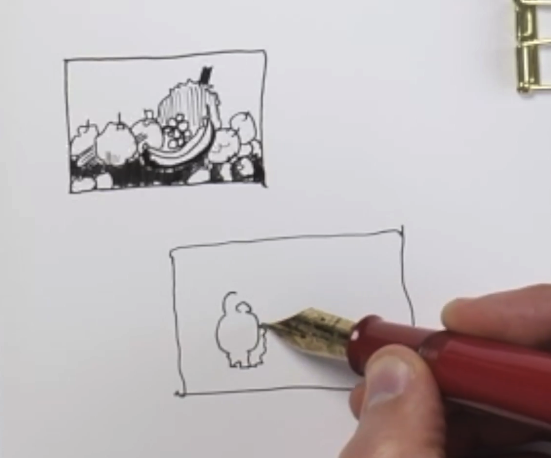
From shapes, comes objects - here simple ideas can be taken from the environment around us. Or even from our own imagination, and build up on the page in a similar fashion to the shapes.
Now it becomes more complex and more fascinating.
Contrast
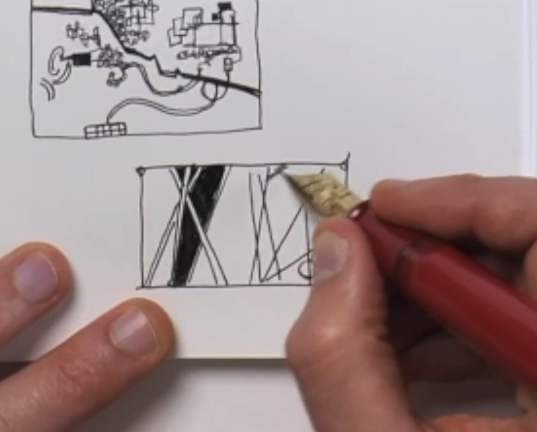
Contrast is KEY in generating a sense of depth - that might be blocking in areas. It might be hatching. It might be texture. It might be leaving areas white.
The key though is to have contrast within your image.
Story telling...
This is where things get really exciting.
You can repeat these simple ideas above, moving around the page.
When you get bored, you move elsewhere. Or even stop for a break.
As these patterns and techniques build up on the page, you'll notice 'things' developing. Your mind going on tangents.
Perhaps a robot emerges - or a factory? A flower? A spaceship?
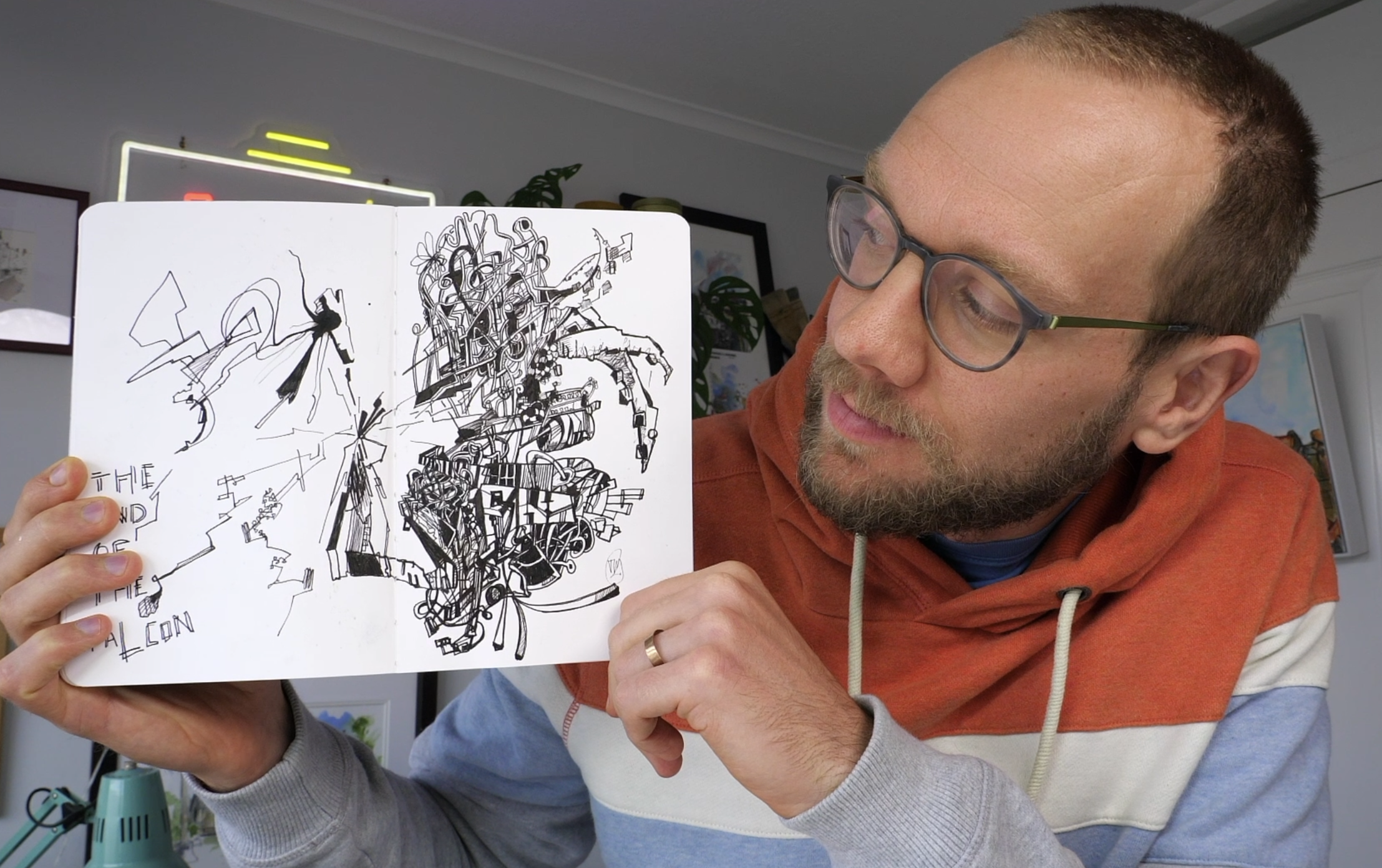
Takje this for example... I called it 'The End of the Falcon' because, as I started drawing, I felt like the outline of the Millenium Falcon appeared and then exploded on the page.
Titles and labels
I really enjoy titling my sketches, it helps me with finding amusement and joy.
These simple titles also help with telling a story.
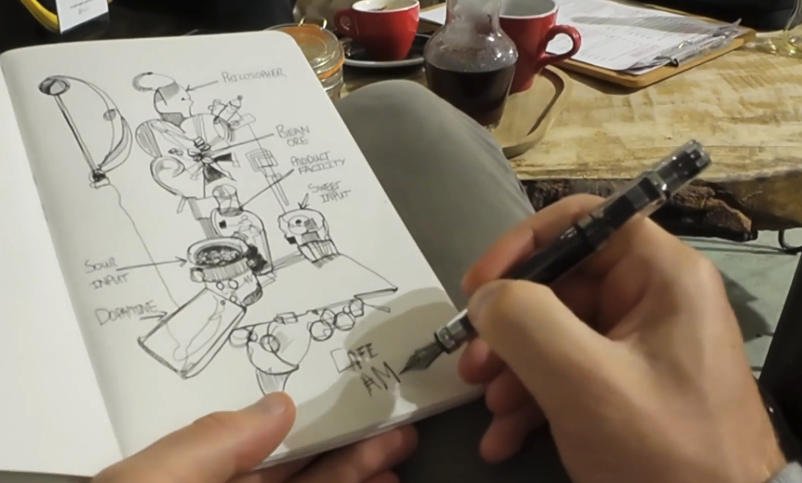
Here is another example - the title is uninspired 'Cafe AM'. But the labels indicate the various objects I was basing my doodle on.
Maybe you can see, for example, the 'bean ore', 'sweet input', 'product facility' and other obscure labels that made me chuckle as I wrote them.
Feeling inspired?
If so check out my YouTube video and join me on SkillShare (https://skl.sh/3MONtgL) to learn more about these techniques!

